
Gihei Kuno, known as the father of Japanese immigration to Canada, moved from Mio Village in Wakayama Prefecture (present-day Mio, Mihama-cho, Hidaka-gun) to Steveston, a town at the mouth of the Fraser River in British Columbia, in 1888. There, he witnessed a large school of salmon and reported it to his hometown. Upon hearing the news, the villagers gathered together and headed for Steveston, crossing the Pacific Ocean to help their village. Afterwards, Gihei achieved great success in salmon fishing and further contributed greatly to the Japanese community in Canada by running a grocery store and an inn.

Then, approximately 134 years later, in the summer of 2022, Toshio Takai (a resident of Himeji City, Hyogo Prefecture), Gihei's great-grandson, visited Vancouver with his family for five days starting on July 27th. One of the purposes of this visit, following his first visit in 2013, was to meet Darran Yelton, a totem pole sculptor for the Squamish Nation, an Indigenous group. Mr. Takai also supported a town revitalization project initiated by Sammy Takahashi, president of the Japan-Canada Chamber of Commerce in Vancouver, with the hope of reviving exchanges between Mihama Town and Vancouver and revitalizing the town. As a contribution to the village where his great-grandfather grew up, he provided full financial support and donated a totem pole created by Mr. Yelton, along with a bronze statue of Gihei, to the Canada Garden in the Mio district of Mihama Town (adjacent to the south side of the Canada Museum) as a symbol of friendship between Canada and Japan.
In addition to the memorable meeting with Mr. Yellton, Mr. Takai's visit to Canada included several international cultural exchange events.

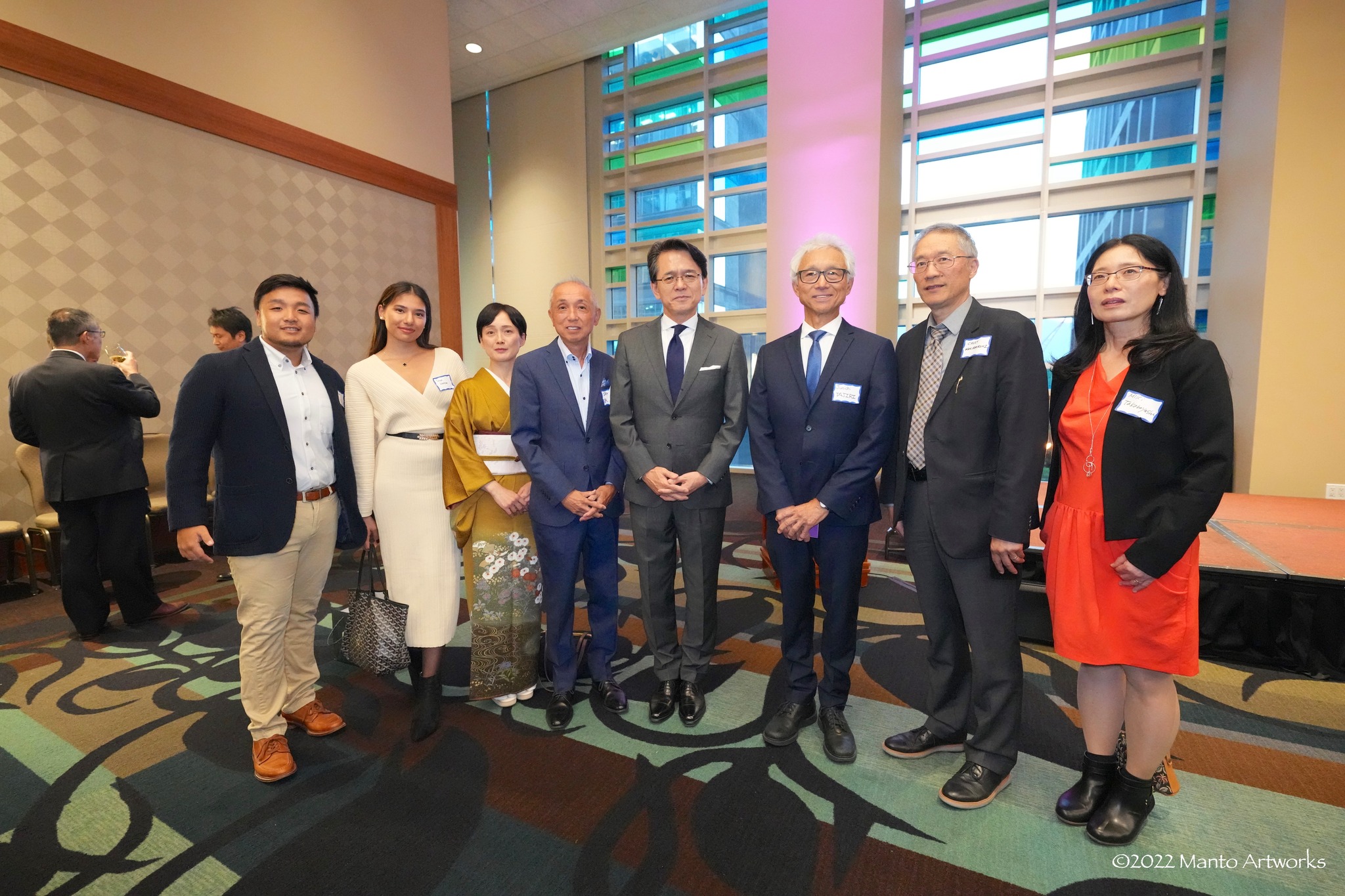
On July 28, the day after his arrival, he paid a courtesy visit to Consul General Hatori in Vancouver. The Consul General, who was present when the totem pole sent to Mihama Town was painted, said that he was particularly impressed by his role as the calligrapher and the act of painting it black. That afternoon, he visited Mayor Malcolm Brodie at Richmond City Hall. The Mayor emphasized the historical significance of the Japanese community in Steveston in Richmond, and told those present that Gihei Kuno's contributions in that sense were very great.
On July 29th, the third day of their visit, a welcome party for Mr. Toshio Takai was held, hosted by the Japan-Canada Chamber of Commerce. Mr. Yellton attended with his family and finally achieved his long-held wish to meet Mr. Takai. Mr. Takai gave a lecture titled "What Gihei Kuno Left Behind," in which he spoke about the family tree that connects him to the Kuno family. Afterwards, Mr. Yellton welcomed Mr. Takai and his group with Squamish songs and drumming. After Mr. Yellton finished speaking about his admiration for Gihei Kuno and the totem poles he carved with feelings of friendship between Canada and Japan, the two men shook hands warmly and firmly.

On the 30th, the fourth day of the visit, we were given a tour of the site where a totem pole sculpted by Mr. Yellton, who is based in North Vancouver, was erected.
During this visit, Mr. Takai and his group had the valuable opportunity to meet with Japanese Canadians with ties to Mihama-cho, Mio. Their encounter with siblings Heidi and Keith Murao, who were born and raised in Vancouver, brightened the future of Mihama-cho. The siblings told them that the family home where their grandparents, originally from the town, lived remains vacant and still stands in the town. It was then proposed that this old house be donated to the International Cooperation Promotion Council, a special non-profit organization chaired by Mr. Toshio Takai. Furthermore, it was decided that it would be used as the Nishihama Seminar House, a facility for exchange between Japan and Canada, with implementation planned for the near future. There are already groundbreaking plans to renovate the interior of this old house, located near the Canadian Museum where a totem pole is erected, in a modern style with the cooperation of a renowned architect.
In the latter half of his visit, Mr. Takai also participated in the Vancouver Asahi Army Memorial Service. The Powell Festival, a Japanese Canadian festival that has been held for 46 years, was held in person this year for the first time in three years. A memorial service was held to pay tribute to the players of the team who played an active role before the war. The organizing committee for the service was run by Sammy Takahashi, one of the founders of the Vancouver New Asahi Army. Kei Uenishi, the only surviving player of the Vancouver Asahi Army who played an active role before the war, was welcomed from Kamloops, and Reverend Aoki of the Vancouver Buddhist Church offered incense. It was of great significance that two great-grandchildren of pioneer immigrants participated in this memorable memorial service wearing the bright red jerseys of the Vancouver New Asahi Army. They knew of the existence of Gary Kono, who was born and raised in Canada, but had never had the opportunity to meet him until now. On this visit, the great-grandchildren and their families met for the first time, and the two shook hands with beaming smiles. It was a moving scene that was a fitting finale to this visit.
Although his visit to Vancouver was a short five days, the encounters and interactions with many people connected to his great-grandfather, including the indigenous sculptor Yelton, surely made the trip invaluable. Just as Gihei Kuno gave courage and hope to the villagers of Mio and led them to emigrate to Canada about a century and a half ago, Mr. Toshio Takai has become a bridge to Canada by erecting a totem pole, a symbol of friendship and peace among the Canadian Indigenous people, and has brought hope and joy back to his great-grandfather's hometown. Feeling confident about further active exchanges between the two countries, including his plan to establish the Nishihama Seminar House, which will serve as a center for learning about international relations, culture, and history between Canada and Japan, he departed for Japan on August 1st.
Sammy Takahashi, the chairman who spearheaded Mr. Takai's visit and accompanied him to all the events, said: "Mr. Takai is carrying out town revitalization activities similar to those of his great-grandfather, Gihei, who wished for the survival of his beloved hometown, Mio Village. I expect that international cultural exchange activities between Mihama Town and Vancouver will become even more active in the future. Activities like these, which respect the history and culture of immigrants, will eventually lead to tourism and business activities between Japan and Canada, and will contribute not only to the Japanese community but also to the prosperity and happiness of people in both countries."
Chairman Sammy Takahashi spoke about the importance of diverse exchange activities. Immediately after Mr. Takai's visit, I had the opportunity to visit the Japanese Canadian Cultural Centre and Museum in Burnaby, British Columbia. As I walked through the museum, the words "Generations of Resilience, the power to overcome difficulties and rise again, passed down through generations" caught my eye on the wall next to the stairs leading to the second floor. I realized that the power passed down through generations could also be seen as the power of people connecting with each other and surviving together. As I wrote about the many encounters that Mr. Takai and his group had fostered, I was reminded of the importance of continuing the "connecting" activities that form the foundation of international exchange.
Article contributed by an event reporter for the Japan-Canada Chamber of Commerce in Vancouver.
References:
- Masumi Izumi, *The Japanese Canadian Movement: The Migration and Movement of Japanese Canadians - An Untold History of Japanese People's Transnational Lives* (Kojima Yushobo, published January 2020)
- https://ja.wikipedia.org/wiki/工野儀兵衛
- Descendants of Gihei Kuno go to Canada https://hidakashimpo.co.jp/?p=22853&=1
- A totem pole has arrived in Mihama Town!http://www.town.mihama.wakayama.jp/docs/2021051200018/