
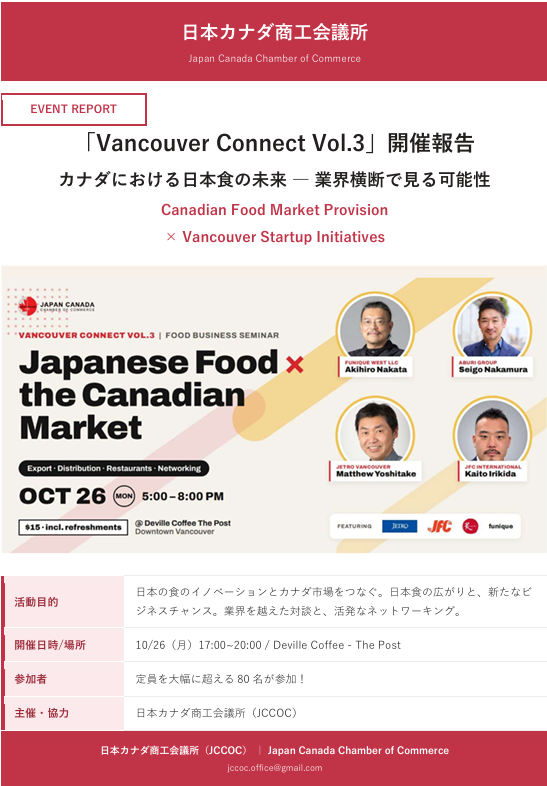
"The Future of Japanese Food in Canada: A Cross-Industry Perspective on Potential"
Connecting Japanese food innovation with the Canadian market. Over 80 participants attended, far exceeding the capacity!
On Monday, October 26, 2026, the Japan-Canada Chamber of Commerce (JCCOC) hosted "Vancouver Connect Vol. 3" at Devils Coffee Lounge inside The Post in downtown Vancouver.
This time, under the theme of "The Future of Japanese Food in Canada – A Cross-Industry Perspective," we invited entrepreneurs challenging themselves to enter the Canadian market from Japan, as well as representatives from leading companies and government agencies in Canada's food industry, to give presentations, participate in a Fireside Chat (discussion), and hold a networking exchange session.
On the day of the event, 80 people attended, significantly exceeding the capacity of 50. Despite the program lasting three hours, from 5 PM to 8 PM, most participants stayed until the end, listening attentively to the speakers. Lively question-and-answer sessions and interaction among participants continued, making it a much more successful event than expected.
The spread of Japanese food and new business opportunities
In recent years, Japanese food culture has been steadily gaining traction in Vancouver.
Starting with Edamame and Matcha, dishes like Temaki and Onigiri have also begun to appear on common restaurant menus. At grocery stores, there is growing interest in Japanese rice varieties such as Koshihikari, Akita Komachi, and Kinmemai.
Against the backdrop of these market changes, this event brought together leading companies and government agencies from various sectors surrounding Japanese food to discuss the potential and challenges of the Canadian market from diverse perspectives, including food ingredient exports, restaurant management, food distribution, and government export support.
Presentations by four speakers
① funique west LLC. Representative: Akihiro Nakata
An entrepreneur aiming to export fragrant rice from Kochi Prefecture in Shikoku to the Canadian market and launch an onigiri (rice ball) business there.
We introduced a new business model that combines the high quality and freshness of Japanese rice with onigiri (rice ball) sales and e-commerce operations.
On the day of the event, Kochi Prefecture's fragrant rice, known for its popcorn-like aroma, was actually cooked and offered to participants for tasting. Beer made with this fragrant rice was also on display, attracting attention from the audience.
During the trip, they visited local Japanese supermarkets, restaurants, and food distribution companies, actively researching and exchanging opinions on competing American brands and local consumer needs. This was an introduction to their new challenge of bringing Japanese ingredients to the Canadian market.
② ABURI GROUP Representative Masatake Nakamura
Mr. Nakamura is the representative of ABURI GROUP, which has been operating high-end sushi restaurants such as "Miku" and "Minami" and "ABURI MARKET" for over 15 years, starting from Vancouver.
He is a pioneering entrepreneur who connects Japanese and Canadian food cultures, for example, by bringing a business model that was successful in Canada to Japan.
This presentation will cover the use of IT and data in restaurant management, as well as the redesign of the supply chain, from ingredient procurement to delivery to customers.
The detailed explanations, based on data accumulated from actual store operations, were persuasive, and participants showed great interest in the creation of a new food distribution system that would satisfy all three parties: food suppliers, restaurants, and customers.
③ JETRO Vancouver, Mr. Masaharu Yoshitake
JETRO, which supports the overseas expansion and trade promotion of Japanese companies, provided an overview of export trends for Japanese food products in Canada and the government's support measures.
This presentation will cover the current status of expanding exports of agricultural, forestry, and fishery products and food from Japan to Canada, as well as specific support programs offered by JETRO, including matching with overseas buyers, developing export strategies, conducting market research, and providing business negotiation support.
In particular, the export value of Japanese rice to Canada increased by 477% from 2020 to 2025, suggesting promising future market expansion.
④ JFC International (Canada) Kaito Irikita, Manager
Founded in Canada in 1906, JFC International has supported the distribution of Japanese and Asian food products for over 100 years.
The company, which boasts one of the largest Asian food distribution networks in North America, shared insights into the latest trends in Japanese food ingredients and changes in the Canadian market.
It was explained that the growing popularity of travel to Japan in Canada is fueling the Japanese food boom, and that interest in organic, low-sodium, and fermented foods is increasing due to a growing health consciousness.
On the other hand, specific information was shared regarding the challenges that Japanese companies face when entering the Canadian market, such as regulations on food additives, tariffs, mandatory product labeling in English and French, and labor shortages.
With data on over 10,000 food items and a logistics and distribution network spanning across North America, the company plays a crucial role in expanding the market for Japanese food products.
Cross-industry dialogue and active networking
Following the four presentations, we held a Fireside Chat (discussion).
New entrepreneurs challenging the Canadian market from Japan, established entrepreneurs who have successfully built businesses in Canada, companies supporting food distribution, and government export support organizations—each from their different perspectives, exchanged frank opinions and real-world experiences.
Participants actively asked questions, and a lively discussion unfolded with the speakers and the audience becoming one.
Furthermore, the event included tastings of fragrant rice, fostering interaction between speakers and participants, as well as among participants themselves, creating a networking opportunity that suggested new business possibilities.
In particular, the fact that 80 people participated, exceeding the capacity by 30, and that many people stayed at the venue to continue interacting until the end of the three-hour program, is one of the major achievements of this event.
JCCOC's initiatives: Connecting Japan and Canada
The Japan-Canada Chamber of Commerce (JCCOC) serves as a business network connecting Japan and Canada, supporting Japanese entrepreneurs and startups in their expansion into Canada.
This event, sparked by the challenge of introducing Kochi Prefecture's fragrant rice to the Canadian market, allowed us to create connections with influential local companies and government agencies, providing participants with an opportunity to gain a comprehensive understanding of the current state and future prospects of the Japanese food industry.
Going forward, we will continue to work on building networks with local partner companies and related organizations, providing hands-on support to entrepreneurs, and creating new opportunities through seminars and networking events.
From Miyanabe, Event Director
In this Vancouver Connect Vol.3, we were able to connect entrepreneurs from Japan who are challenging themselves to enter the Canadian market with companies that have already established a track record there, as well as government agencies.
I am delighted that this event provided participants with an opportunity to hear directly from leaders in various sectors of the food industry—a group they rarely have the chance to meet in one place—to gain an overview of the industry as a whole and discover new business possibilities.
In particular, the fact that 80 people participated and that the enthusiastic exchange continued until the very end, despite the long duration of three hours, was a great encouragement to us as organizers.
Going forward, JCCOC will continue to cherish the connections between entrepreneurs, companies, and people in Japan and Canada, and contribute to the development of business and the economy in both countries.
I would like to express my sincere gratitude to everyone who spoke at the event, everyone who participated, and everyone involved who cooperated in making this event possible.
